North Korea goes to great lengths to keep a low-profile from the rest of the world. Naturally, all of this secrecy garners a great deal of curiosity. Photographer Michal Huniewicz captured illegal photos of the mysterious and intriguing country.
No Exceptions Made
It is clear in this photo that law and order come first, as these two women and a child rush to clean the street in front of a guard, who is observing their every move. In North Korea, if one person violates any of the country’s laws, the punishment applies to their whole family. A three-generation punishment is put in place, meaning that grandparents, parents and their children are required to serve the punishment alongside the violator.
Look Supreme Leader, I’m On TV!
Television programming in North Korea is highly controlled and monitored, and there is only state provided programming. Only three channels are available, while two of them are available during the weekend and the other in the evenings. As a result, there is a small piracy community who smuggle second hand video recorders from China, featuring tapes of South Korean TV soap operas. Additionally, apart from a controlled domestic network, there is no internet access in the country.
Their Faces Say It All
These commuters look beyond just unhappy. They look as though they are devoid of any capability of caring or having hope anymore. Naturally, there are many citizens who oppose the Juche ideology but are too afraid to speak up about it. The human rights of North Koreans are constantly being put into question and there have been numerous stories of citizens who have defected to South Korea in order to pursue a more liberal life.
Let’s Get Political
Interestingly, even though outside cameras are prohibited, the people in the image do not seem to have any qualms about being photographed, particularly in front of a government building. As far as politics are concerned, the country does hold an “election” every five years. However, only one option appears on the voting ballots, meaning that the outcome is always the same. The country’s constitution is available to read. However, freedom of expression and democratic voting don’t seem to be values actually put into practice.
Not Allowed
Along with many other restrictions, some of the items that tourists have been banned from entering the country with include cameras, cell phones and adult literature. But despite common misconceptions, tourists can bring cell phones into the country, as long as they purchase a local SIM card to use them with, albeit reception being notoriously poor. You are allowed to take photos, as long as it’s with a tour guide’s permission. So Michal Huniewicz had to smuggle his camera in to capture some of these secret images.
Big Brother Is Watching
We’re not sure if this kind of activity is prohibited in North Korea as well, but nothing is stopping this man from answering nature’s call. Mass surveillance is a standard procedure in the country, with a vast network of informants who will report to the authorities if they spot any citizens who they suspect may be participating in criminal behavior. The people of North Korea are constantly under surveillance in what has been described as a “police state.”
Interesting Trip, To Say The Least
As a tourist in North Korea, you must be accompanied by a guide at all times, and the guide instructs you on when to sleep and eat. No freedom of choice, even for visitors. North Korea regulates its tourism through state-owned tourist organizations. Only 4,000-6,000 tourists from the western world visit North Korea every year, and this is partly due to the difficulty of getting to the country. Tourists can only fly to Pyongyang from five airports: Beijing, Shenyang, Kuala Lumpur, Shanghai or Vladivostok.
A World Apart
With China being separated by only a small body of water, we can see the stark differences between the two countries. One depleted and held back by its government, and the other standing tall with its skyscrapers and accomplishments. Although not visible in this photo, there is the Sino-Korean Friendship Bridge. This construction is a physical manifestation of the two countries’ relationship. China has historically been one of North Korea’s only true diplomatic allies. It connects the cities of Dandong and Sinujiu.
Bus Privileges
Due to North Korea’s nature to closed itself from the wider world, there is little information surrounding the way that the bus systems operate in major cities such as Pyongyang. But we do know that in order to take the bus and other public transportation, citizens of North Korea must obtain a valid permit. The Pyongyang trolleybus system has been in operation since 1962. The capital isn’t the only city that has such systems either. About 12 to 15 other cities have trolleybuses as well.
Statue Photography
In this photo can be seen the legs of Kim Il-sung. It is one of the two statues that stands at the Mansudae Grand Monument, a location in Pyongyang. Citizens travel to the monument daily to pay their respects to the two former leaders. However, this photo caused a violation in North Korean policy. It is said that all photographs of statues must include the entire figure. Not only did this photographer break the rule, but he also smuggled a camera onto the premises.
North Korean Soldiers
Though a risky photo to take, the photographer captured a real moment in which the soldiers are caught slightly off-guard, looking a little less stern than usual. Kim Jong-un is the Supreme Commander of the KPA (Korean People’s Army), which includes ground force, navy, air force, strategic rocket forces and special operation force. Over 25% of the population serves in the KPA and as of 2016, with a 5,889,000 strong personnel, the KPA is officially the largest paramilitary organization in the world.
Not Enough Funding
Engineers must carry their equipment from one side of the city to the other due to lack of funds that would allow easier and more convenient transportation. In a country where half the population lives in poverty and lacks access to basic human needs, there are some billionaires with more money than North Korea. Microsoft co-founder Bill Gates’ net worth of $87.4 million USD is considerably greater in comparison to the Far East country’s GDP of $12.38 million USD.
One City Stands Apart
In contrast to the poverty that is commonly found in the rest of the country, capital city Pyongyang is gleaming and well developed. The city has risen from the ashes since being completely decimated during the Korean War. The reconstruction of the city was a reflection of Kim Il-sung’s vision, to have a capital city that would help boost morale. Modern day Pyongyang is complete with fancy boulevards, public buildings and various monuments. And like the country itself, the city is laid out orderly.
You Shall Not Pass
As a guard stands by to maintain order, people on bicycles wait for a train to pass before they can cross the path they are on. Freedom of movement is heavily regulated by the government and traveling within the country is tightly controlled. Limited freedom means that the country’s citizens, on many occasions, are not allowed to move freely around the country. If one is caught trespassing on premises or traveling to locations they shouldn’t, punishment can include detention and conviction of illegal traveling.
Farming Is Key
North Korea does not receive imports from other countries, therefore the crops that they cultivate are crucial for their sustenance and survival. However, vast improvements have been made to North Korea’s agricultural system since the turn of the century, making the country pretty much self-sufficient in staple foods. Since the 1950’s, a majority of North Koreans have received food through a government run system called Public Distribution System (PDS). Today, about 70% of the population receives food this way.
A Different Kind of Recycling System
Human waste is converted into fertilizer, which is crucial for farming and cultivating the crops that are distributed all over the country. It has been widely reported that North Koreans are being forced by the government to make fertilizer. A reporter in China claimed that “North Korea has almost no chemical fertilizer, so the government ordered every person to produce hundreds of kilograms.” In North Korea, fertilizer is made using human feces and straw.
The Bronze Statues
In this photo can be seen the Mansudae Grand Monument, a complex featuring statues of the first two leaders of North Korea, Kim Il-sung and Kim Jong-il. Under Il-sung’s leadership, North Korea evolved into a workers’ state, while Kim Jong-il was thought to have brought a more authoritarian approach than his father. The photographer who captured this photo was undertaking a very big risk by doing so, as he could have been arrested and his guide would have been tortured for participating in “espionage.”
Transportation Mirage
There is a lot mystery surrounding North Korea’s railway stations, with some speculating that the reason that they are built so deep is in order to double up as nuclear bunkers. Even though there were no trains leaving that evening, there were people planted in the train station to make it seem as though there is free mobility available in the country. The government employs this tactic to try to portray an image of normalcy to the rest of the world.
War Crimes
Up to 200,000 civilians are imprisoned in North Korea. They are held in prison camps that are enclosed by electric fences. Some of the prisoners have been accused of political crimes, and many even have had their extended family imprisoned along with them. Any alleged criticism of North Korea’s leaders is consider one of the worst offenses. Other grave crimes including attempting to flee the country, especially to South Korea. Any rejection of the regime’s principles is taken seriously by the government.
Permitted Vehicles
Military and government officials are the only group of citizens allowed to own motor vehicles in this dictatorship. All drivers much have passengers and the only way that one is able to drive alone is by having a permit. Driving licenses need to be renewed every year and citizens must always possess a fuel validity document, which confirms whether or not the fuel in a vehicle was legitimately acquired. Also, a mechanical certificate is required to prove that the car works.
Militaristic Minimalism
The common architectural style of buildings in North Korea is very simplistic and linear. You won’t easily find many varying or creative details in buildings, with a style that strongly evokes the socialism that gave birth to Pyongyang. Some of the buildings that clearly epitomize this style include the Koryo Hotel, the second largest hotel in North Korea. The Pyongyang Metro Museum is another fine example of North Korean minimalism. In recent times, new architects have added larger, more sophisticated edifices to the city landscape.
Smoke Up
Despite the strict rules normally associated with a dictatorship such as North Korea, did you know that certain smoking substances are actually legal there? They are not considered to be an illegal substance, and travel bloggers such as Darmon Richter have written about allegedly purchasing certain substances while passing through the country. He wrote, “it seemed appropriate to buy some…and the little old ladies running the stall were happy to load us up with plastic bags full of the stuff, charging us roughly $0.50 each.”
Largest Stadium in the World
North Korea actually has the largest stadium in the world. The Rungrado 1st of May Stadium is a multi-purpose venue that can seat 114,000 people and regularly host extravagant sporting and national events. Its roof has 16 arches arranged in a ring shape, and is believed to have been inspired by a magnolia blossom. The name of the stadium comes from the Rungrado Islet in the Taedong River, where it is located and May Day, the international labor day.
The Ultimate Tourist Attraction
The most popular attraction in North Korea is that of Kim Jong-il’s body, which is displayed in a glass case and is preserved for anyone, including foreign tourists, to see. You can find it at Kumsusan Memorial Palace. Originally, the Kumsusan was built in 1976 and served as Kim Il-sung’s official residence. Following his death in 1994, his successor, Kim Jong-il, converted the palace into a mausoleum for his father. Jong-il is also on display now in a room close to where his father rests.
Extreme Poverty
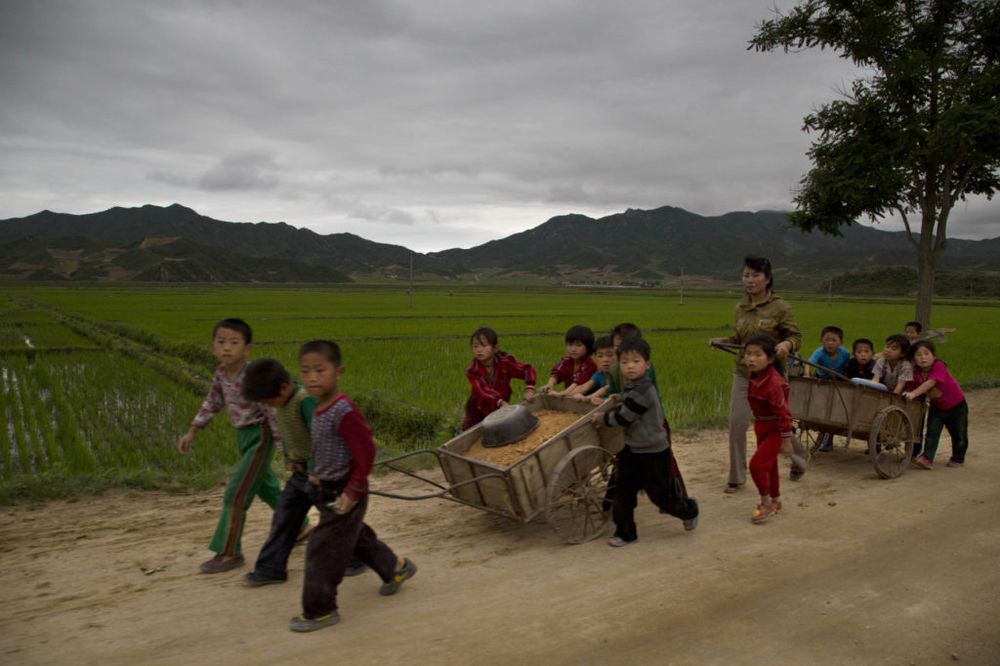
Half of the country’s 24 million population live in extreme poverty. Most do have access to basic human needs. In this picture, taken in North Hamgyong province, school children are helping to fix a pot hole on one of the only roads in the area. The country’s poverty issues have been attributed to its totalitarian regime and its poor governance over its people. Although starvation and famine in the country have been reported in the media, these stories are mainly rooted in rumors.
Birthday Celebrations
This bleak image captures North Koreans gathering in Kim Il-sung Square, Pyongyang to celebrate the birthday of Kim Il-sung. A national holiday celebrates the birthday of the founder and former president of North Korea. It is the most important national holiday in the country and was renamed Day of the Sun, three years after his death. The name alludes to his name, Il-sung, which means “become the sun.” North Koreans celebrate by visiting important sites connected to the former leader.
Life Of A Seamstress
This image of a seamstress at work was captured in a factory in Sonbong, North Korea. The textile factory is what is called “an economic zone,” which the country has introduced in order improve the lives and economic situations outside of the capital of Pyongyang. Clothing accounts for a large chunk of the country’s light industry sector and is a major form of exportation. Due to their strong ties, many Chinese companies utilize North Korea as a production base.
Good Sports
This North Korean soldier is walking past a ski slope that was being constructed in 2013 at Masik Pass. The country’s authorities have gone to great lengths to encourage participation in sports across the nation in recent years. However, despite taking part on the world stage in sports such as soccer, basketball, running, golf and ice hockey, North Korea’s performances have not matched its aspirations. North Korea also made their first appearance in the Olympics in Munich in 1972, winning five medals and one gold.
Give Me Shelter
This man is taking shelter during a rain storm in Samjiyon, Ryanggang province. In the shot you can see the long billboards full of state propaganda. North Korea’s climate has a mix of continental and oceanic elements. The country tends to see warm summers, with a short rainy season called changma, and cold, dry winters. On average, about 60% of rain falls from June to September. Recurrently, late spring droughts will be followed by severe floods. And in June 2015, North Korea faced their worst drought in 100 years.
Just Resting
This man seems to be taking some time out to rest on the grass above a ridge. This photo, taken by photographer Eric Lafforgue, was actually one of the main causes of him being banned for life from North Korea. He had travelled there six times in the past. Sleeping on the job is considered a serious offense in the North Korean military. In 2015, after Kim Jong-un’s defense chief fell asleep during a meeting, the dictator had him executed.
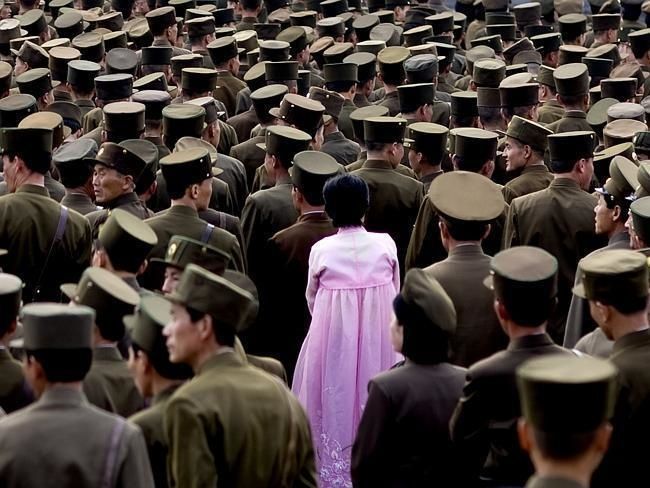
The Lady in Pink
This image, also taken by Lafforgue, is unusual not just because of the contrast with all the soldiers around the lady in pink, but also because pictures of the army are strictly forbidden. How he was able to take a picture of all these soldiers and get away with it is a miracle. The image also asks a wider question: what place does individualism have in a country where everyone is expected to adhere to the ways of one man?
Subway System
Pyongyang’s subway system is the deepest underground system in the world at a staggering 360 feet. The reason being it also reportedly doubles as a bomb shelter for the capital. The system is so deep that it takes nearly four-minutes to descend to train platforms. Foreign visitors are only allowed to visit two of the country’s stations: Puhung and Yonggwang. This is because these two stations are regarded as the most beautiful and were the final stations to be completed.
Road Safety
This incredible image shows these children seemingly sitting in the road while cars fly past. It showcases the changing times in the country where larger portions of the population now own cars and are sharing the makeshift roads with regular pedestrians. In terms of road quality, drivers often swerve and change lanes, sometimes into opposite-direction lanes, in order to avoid potholes. Also, sections of roads under reconstruction may not be signalled properly, causing safety hazards for oncoming traffic.
A Smart Country, Apparently
Oddly, these children are seen posing in front of a computer but it is clear that there is no power and the machines are not turned on. The CIA World Factbook has defined literate people to those who are aged 15 or over who are able to both read and write. Amazingly, North Korea has reiterated that 100% of its population (including both men and women) are literate. But according to UNESCO, 6 countries have 100% literate populations, and North Korea isn’t one of them.
Soldier Show
Here can be seen a crowd of soldiers and family members watching a dolphin show in the country’s capital, Pyongyang. These shows take place at the Rungna Dolphinarium, which is part of the Rungna People’s Pleasure Park, one of the most popular attractions in North Korea. It is located on the Taedong river, close to the Rungrado May Day Stadium. It’s not illegal to take photos of the show, but it is illegal to take photos of the crowd, which is clearly mostly soldiers.
Hitchhikers Guide to North Korea
A common sight in North Korea is soldiers hitchhiking. Since there is no public transportation between major towns and cities, it is the only way they can get around. However, this is where the line is drawn. Unless you serve in the military, you are not allowed to stand by the side of the road and ask for a ride. The local is under threat of punishment if they were to interact with a foreigner without permission.
Not A Labor Of Love
Another common sight in the hermit kingdom is the sad shots of child labor. Young children are seen here slaving away in the fields. Human Rights Watch released a submission to the United Nations Committee, stating that North Korea should stop exploiting children for the regime’s benefit. The country has been accused of putting children through extreme forms of labor, including farming, scavenging for scraps of metal and breaking rocks. The government reportedly masked it as “patriotic labor.”
Cult Of Personality
This photo is of Kim Il-sung’s statue in Pyongyang. The fact that someone left a broom there, even for a minute, is considered highly disrespectful and illegal. For 46 years, Kim Il-sung was the supreme leader of North Korea until his death in 1994. In 1949, Kim had enforced totalitarian rule over North Korea and the communists promoted his cult of personality. This lead to statues of Kim appearing around the country, and Kim insisted that the people referred to him as “Great Leader.”
Picking Grass
This man appears to be harvesting grass. We’re not exactly sure why, but it could be for food. This is common practice in North Korea, with many citizens instructed to mow lawns and trim grass, simply with a pair of tweezers. From public gardens to the Kumsusan Palace, you will find workers picking at grass for hours on end with just tweezers and a small plastic receptacle to ensure perfect patches of grass. Palace lawns are worked on constantly, all year round, even during the cold winters.
No Back Photos
It is forbidden to take photos of monuments or statues of Kim from the back, so the photographer took a huge risk when he did just that. Despite his successors, Kim Il-sung will always be looked at by the North Korean people as their eternal leader. Because of this, the country is considered to be the world’s only “necrocracy.” This basically means that North Korea has a government that still adheres to the policies of a past leader, or a dead one.
No Power
Power outages are very frequent in North Korea. They often affect businesses daily such as this art gallery. NASA has even taken photos the country from space, showing nights when all of North Korea’s lights are out. The country has faced international criticism for its control of electricity. Despite admitting to struggling to get enough power, Kim Jong-un has repeatedly told his people that they are responsible in helping restore resources such as electricity, notably in an editorial called “Right In Front Of Our Eyes.”
All Aboard The Soulless Train
Propaganda is truly everywhere, even on the subway. Photos of Kim Il-sung and Kim Jong-il can be seen above most carriage doors, reminding passengers of their rulers. Tourists have commented in the past how quiet it can be on North Korean trains. Commuters shyly look around but no one speaks, giving train rides a soulless quality. Most people don’t seem to use their smartphones while commuting, but the few who do pull their phones out are completely glued to the screens.
Kim Jong In English
A small selection of English books about the rulers of North Korea are available to purchase within the country. All the books are about North Korean culture and history, while others are about Kim Il-sung and Kim Jong-il. Some detail the life and times of North Korea’s rulers, including collections of anecdotes and words of wisdom that they provided the North Koreans over the years. But many resemble a funeral handout rather than something with factual basis.
Limited Supply
To start off an average day in the not-so-average North Korea, we’ll start off at one of its not-so-average grocery stores. There is only enough produce to provide exactly what is needed, with no excess. For that reason, only locals are allowed to shop for food.
Lunch With A Side of Propaganda
As this waitress goes about her work routine, there is endless propaganda playing on the television in the background of the restaurant. Propaganda in North Korea is based on the Juche ideology, which translates literally into “self-reliance.” It is also focused on promoting the Workers’ Party of Korea, the sole governing party of the entire country. Some of the key aspects of its propaganda revolve around the cult of personality surrounding the Kim family as well as its foreign relations.
Everyday Life
Dressed in similarly simple clothing, this is a glimpse of the daily lives of residents of North Korea. The quality of everyday life throughout most of the country can be difficult but manageable depending on who you are. Travelers have commented that in terms of bare essentials, basic commodities such as soap, underwear, medicines and even certain foods can be hard to come by. Apparently, many stores use candles for lighting. And in Pyongyang, it’s more about who you know rather than what you know.
Friendship Bridge
Here is a picturesque nighttime image of the The Sino-Korean Friendship Bridge. Like many parts of the country, the bridge was was destroyed during the Korean War. The US bombed the bridge in order to prevent supplies from China to North Korea. The bridge was built over the Yalu River, connecting the cities of Sinuiju, North Korea with Dandong, China. Pedestrians are not allowed to cross the bridge and it is one of the only ways to enter or leave the country.
A Meticulous Country
The streets of the city are to be kept clean at all times, and women in uniform attend to this rule. This obviously also applies to the surroundings of the Socialist Revolution Monument, which is also located on the Mansu Hill. Outside of visiting hours, servants are constantly ready to sweep the premises, ensuring that the site remains meticulous at all times. And it makes sense that it couldn’t be a one-man job, as the monument is huge.
The Missile Issue
The missile program in North Korea was developed in the 1970’s along with help from the Soviet Union. This is still a huge hot button topic in international news today. Also, North Korea has been accused of selling weapons and nuclear technology to countries in Africa and the Middle East. For example, the UN discovered a North Korean shipment of about 450 graphite cylinders that were heading to Syria. They were meant to be used for ballistic missiles.
Dog Soup
A local cuisine in both North and South Korea is Bosintang, or dog soup, which contains dog teeth. Also known by many other terms, such as yeongyangtang and boyangtang, the dish includes meat, spices and vegetables such as green onions which are boiled. Bosintang has been a long-lasting staple of Korean cuisine. However, dog soup has been the subject of criticism from the outside world in recent times, particularly in the western world where dogs are considered “man’s best friend.”